Anthropic tests how devs react to yanking Claude Code from Pro plan is attracting attention across the tech world. Analysts, enthusiasts, and industry observers are watching closely to see how this story develops.
This update adds another signal to a fast-moving sector where product decisions, platform changes, and competition can quickly shape the market.
Anthropic has removed Claude Code from its Pro subscription plan, as reported by some of its public-facing web pages, but the company says it’s only a test for a small number of users.
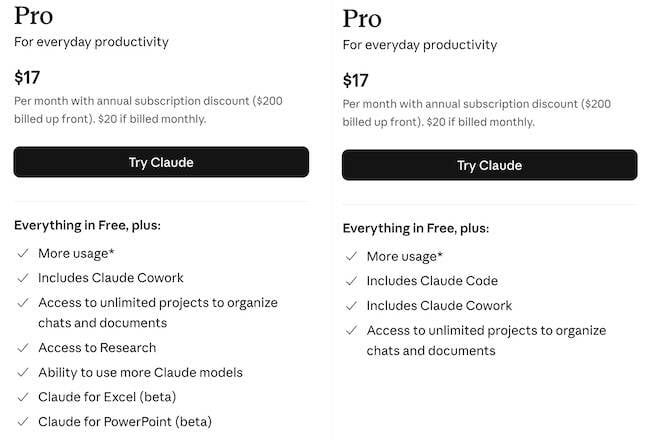
On Monday, the company's pricing web page stated its Pro plan “includes Claude Code." On Tuesday, that phrase is no longer present, and elsewhere on the page, the feature list for the Pro plan includes an explicit "X" rather than a check mark for Claude Code. The changes were previously noted by AI industry skeptic Ed Zitron.
Anthropic’s changed product inclusions have not reached all corners of its site. At the time this article was filed, the Claude Code product page still stated the Pro plan provides access to the code generation tool. And when this reporter accessed Claude Code from the CLI, the terminal output still says "Claude Pro."
Screenshot of different Anthropic web pages showing Claude Code subscriptions – Click to enlarge
Claude.ai, when queried about this, insisted that the Pro plan includes Claude Code, but one of the cited documentation pages, updated today, mentions only the Max plan.
Losing access to Claude Code understandably alarmed developers and that sentiment reached Anthropic, whose head of growth Amol Avasare published a social media post indicating that the change represented an experiment.
Why Anthropic felt that the update to its public-facing pricing page would address only some users and not the entire internet isn't entirely clear. And a company spokesperson did not respond to a follow-up question about that.
Avasare went on to explain: "When we launched Max a year ago, it didn't include Claude Code, Cowork didn't exist, and agents that run for hours weren't a thing. Max was designed for heavy chat usage, that's it.
"Since then, we bundled Claude Code into Max and it took off after Opus 4. Cowork landed. Long-running async agents are now everyday workflows. The way people actually use a Claude subscription has changed fundamentally.
"So we're looking at different options to keep delivering a great experience for users. We don't know exactly what those look like yet – that's what we're testing and getting feedback on right now."
Anthropic has been taking steps recently to limit usage of its AI models to dampen demand amid tight capacity, a problem also faced by GitHub and Google. Claude in its various forms has become exceedingly popular in the past few months, and the advent of projects like OpenClaw led many developers to create agents using Claude models.
The basic problem is that Anthropic's subscription plans charge far less than the book value of tokens consumed, sometimes by a factor of ten or more. The company introduced usage limits last month to encourage use during off-peak hours, much as a power utility might do to prompt energy conservation. As noted by Avasare, Anthropic is exploring further usage limitations.
What's striking about the transition is not so much that it happened but the lack of coherent communication to customers. Maybe Anthropic feels doesn't need to offer fair warning or clear announcements of plan changes to individual customers who pay a mere $20 a month.
Enterprise customers, however, don’t like that sort of uncertainty and may worry that Anthropic doesn't consider customer relations a priority.
Why This Matters
This development may influence user expectations, future product strategy, and the competitive balance inside the broader technology industry.
Companies in adjacent segments often react quickly to similar moves, which is why stories like this tend to matter beyond a single announcement.
Looking Ahead
The full impact will become clearer over time, but the story already highlights how quickly the modern tech landscape can evolve.
Observers will continue tracking the next steps and how they affect products, users, and the wider market.