Scientists have developed a tailored ionic liquid that stabilises perovskite solar cells, allowing them to retain about 90% efficiency after 1,500 hours at 90°C under continuous light, overcoming a major hurdle to commercial adoption.
Custom ionic liquid enhances perovskite stability, 90% efficiency 1,500 hours at 90°C
Click Here to Add Gadgets360 As A Trusted Source

Researchers from Purdue University and Emory University have announced an ionic liquid additive that significantly retards the breakdown of halide perovskite solar cells. Perovskite PV is a technology that has the promise of inexpensive but high-efficiency solar energy, although it generally fails quickly in high heat and light. This group demonstrated that cells in which the new additive was added retained approximately 90 percent of their activity at 90 °C after 1,500 hours of continuous light activity.
Tailored ionic-liquid additive
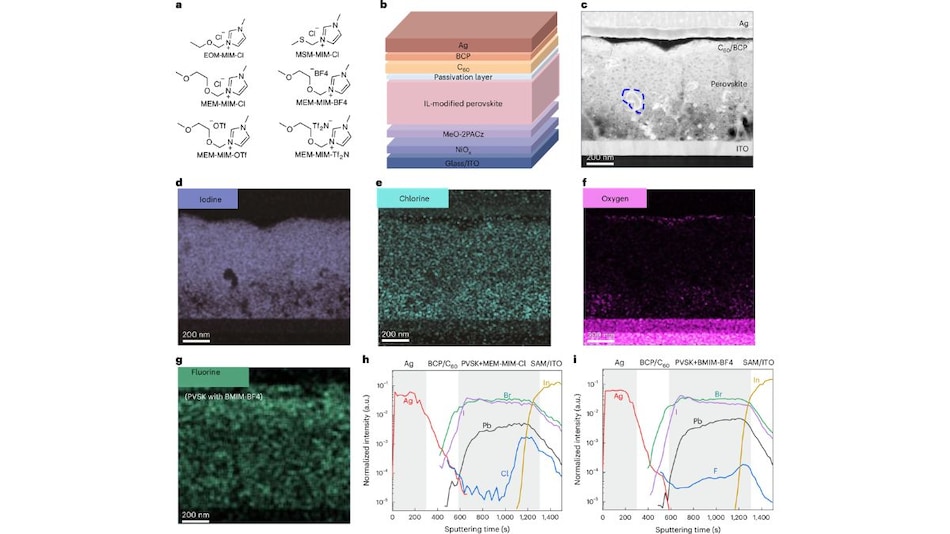
According to the paper, the researchers synthesised a custom ionic liquid, methoxyethoxymethyl-1-methylimidazole chloride (MEM-MIM-Cl), with an ethylene glycol ether side chain designed to “tune” perovskite crystal growth and stabilise buried interfaces (e.g., at the NiOx layer). When added to the perovskite precursor, MEM-MIM-Cl induces an intermediate crystalline phase by chelating undercoordinated lead ions. This dramatically lowers defect density and passivates trap sites. By curing up these defects, the additive slows the degradation pathways (from heat, light, or moisture) that normally shorten device lifetimes.
Record-breaking stability under heat
The best cells treated with MEM-MIM-Cl achieved 25.9% power conversion efficiency in laboratory tests, and after 1,500 hours at 90°C under one-sun illumination, they retained roughly 90% of that output. These outcomes significantly surpass earlier stability benchmarks. In contrast, a 2024 study discovered that a polymerised ionic-liquid additive allowed a perovskite cell to sustain approximately 87.6% of its efficiency following 1,500 hours of continuous light.
The Purdue team points out that MEM-MIM-Cl is compatible with large-scale manufacturing because it can be readily synthesised and applied using conventional solution processes (like blade coating).