ESA images reveal a city-sized butterfly crater on Mars with smooth wings likely formed by ancient water.
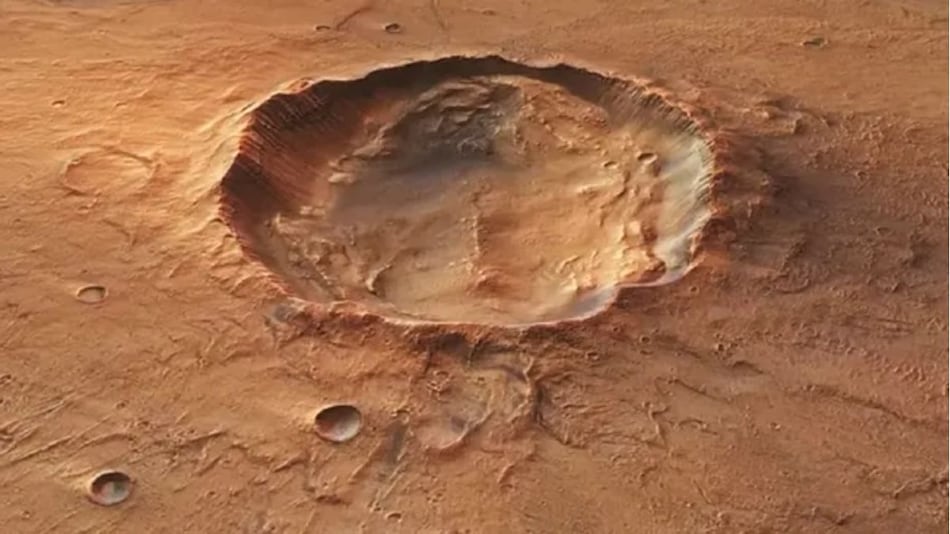
Mars’ butterfly crater shows smooth, water-influenced wings across the Red Planet’s northern lowlands
Click Here to Add Gadgets360 As A Trusted Source

A city-size “cosmic butterfly” crater on Mars can now be seen in stunning detail from the European Space Agency (ESA), providing a new perspective of the Red Planet’s watery past. The feature, located in the region of Idaeus Fossae, is approximately 12.4 miles (20 kilometers) from east to west and 9.3 miles (15 km) north to south; it is almost as big as Manhattan. Created by an asteroid, the crater is smooth, with wing-like outcrops against its uneven center shaped like a walnut. ESA’s Mars Express orbiter, which has surveyed the planet since 2003, digitally reconstructed the crater for this detailed view.
ESA Reveals How “Butterfly” Craters on Mars Reveal Impact Dynamics and Subsurface Ice History
According to an ESA report, the smooth wings may result from a layer of buried Martian ice melted by the impact and mixed with debris to form fluidised terrain. Unlike the usual craters that one would find on Earth, which are rounded and nearly circular, this asymmetrical crater was created when the asteroid impacted at an oblique angle, dispersing debris to its north and south differently. Scientists say studying such butterfly craters can reveal the angle, force, and history of ancient impacts, as well as conditions beneath the Martian surface at the time.
ESA observed a similar elongated butterfly crater in Mars’ southern highlands in 2006; comparing these structures reveals impacts, ice interaction, and Mars’ geologic and hydrologic history.
Mars’ “Animal-Shaped” Features Reveal Surface Processes and Ice Distribution, Highlighting Pareidolia and Impact History Insights
The findings summarise “animal-shaped” formations on Mars, including rocks resembling turtles and corals, and cracks shaped like the outline of a spider, which can be attributed to pareidolia, with implications for processes on the surface and ice distribution.

Researchers say that ongoing imaging of Mars’ northern and southern lowlands may reveal more butterfly craters, which could in turn assist in charting the Red Planet’s impact history and the influence of water on its surface over billions of years.