Scientists have directly observed a black hole dragging and twisting spacetime for the first time.
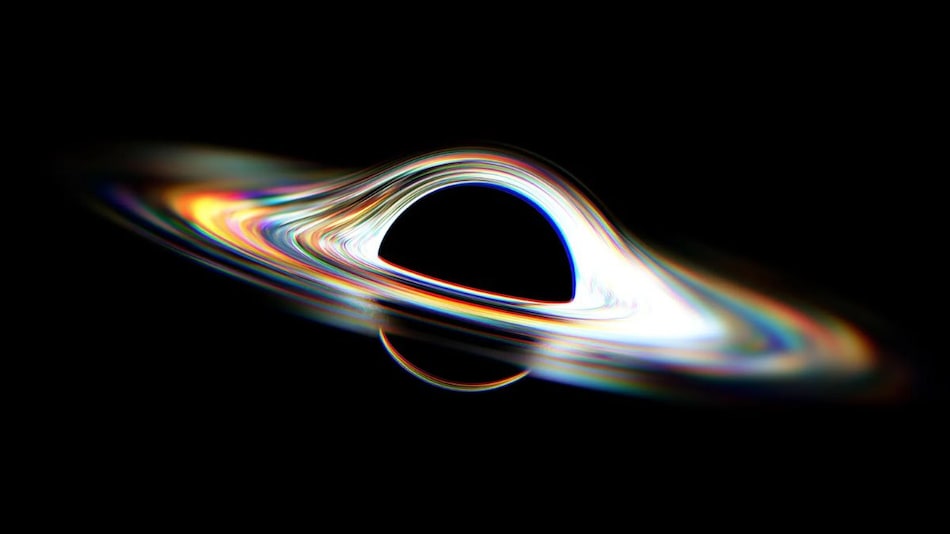
Artist’s view of a spinning black hole dragging spacetime during a stellar destruction event.
Click Here to Add Gadgets360 As A Trusted Source

Astronomers have, for the first time, directly observed “spacetime being bent into a near-black hole” in a dramatic demonstration of Albert Einstein’s general theory of relativity. Scientists spotted the rare effect when a distant star was destroyed by a supermassive black hole, causing bursts of X-ray and radio light. By following a repeating cosmic wobble in the remnants of the star, scientists realized that spacetime itself was being dragged along by the black hole’s rapid spin. This observation offers fresh information about how black holes spin, draw in matter, and launch jets of material very close to the speed of light.
Wobbling Star Debris Around Black Hole Reveals Elusive Frame-Dragging Effect
According to a report published in Science Advances, the finding arose from observations of a tidal disruption event called AT2020afhd, in which a star was torn apart by a supermassive black hole. Conducted by the National Astronomical Observatories of the Chinese Academy of Sciences, and with significant input from scientists at Cardiff University, the research centred on peculiar repeating signals emerging from the event.
As the star got ripped apart, its material formed a rotating disk around the black hole while launching jets that lurch forward in harmony, showing frame-dragging.
Einstein’s Spacetime-Twisting Effect Finally Seen Around a Rotating Black Hole
Lense–Thirring precession happens when a rotating black hole drags spacetime around with it, making material close to the black hole wobble. Einstein proposed the principle in 1913 and outlined it in 1918, but direct evidence for the effect had not been found until now.


By combining Swift X-ray and the Very Large Array radio data, the team concluded spacetime dragging and unlocked a new window into black hole spin and jet structure.